What Is the Guaranteed Analysis?
The guaranteed analysis (GA) is a regulated panel that's legally required on every bag of livestock feed sold in the U.S., under standards set by the Association of American Feed Control Officials (AAFCO) and enforced state by state. Manufacturers must meet or exceed the minimums — and stay under the maximums — printed on the bag, which makes the GA the one part of the packaging you can take completely at face value.
Four numbers make up the core of it for rabbit feed: crude protein, crude fiber, crude fat, and vitamin A. None of them are arbitrary — each one exists because of something specific happening inside a rabbit's body. Below is the physiology behind each one, a comparison of twelve feeds widely used by ARBA and 4-H show breeders, and a short guide to reading the ingredient list beneath the GA panel.
The Core Four, and Why They're There
Each of these numbers earns its place on the bag for a specific physiological reason — not as an industry convention.
Protein
Protein is broken down into amino acids during digestion, which the body then reassembles into muscle tissue, milk proteins, enzymes, hormones, and — notably for rabbits — keratin, the structural protein that makes up roughly nine-tenths of fur. That's why a protein-deficient rabbit often shows it first in a dull, thin coat, well before anything else becomes visible.
University extension research breaks protein requirements down by production stage: roughly 12–15% for a dry doe, herd buck, or resting adult, and 16–20% for a doe that's pregnant or nursing a litter. Most commercial rabbit feeds, though, are formulated as a single all-purpose ration rather than a separate bag for every life stage — which is exactly why the large majority of established show feeds land at 16–18% protein. That range is high enough to cover a lactating doe or a rabbit being conditioned for the table without a breeder needing to keep two different feeds on hand.
Too little: slowed growth, thin or brittle fur, smaller litters, lower weaning weights. Too much: not directly harmful to a healthy rabbit, but the excess nitrogen has to be filtered by the kidneys and excreted, which means more ammonia in the urine and unnecessary cost for no real benefit.
Fiber
A rabbit's digestive system runs on a process unique among common livestock: hindgut fermentation. Long, indigestible fiber passes largely intact into the cecum, a large fermentation chamber where bacteria convert what they can into volatile fatty acids and B vitamins. The rabbit then eats the resulting soft droppings — called cecotropes — directly, to reabsorb those nutrients. This is called cecotrophy, and it's a normal, essential part of how a healthy rabbit digests, not a hygiene problem.
That same coarse fiber also acts as a physical "scratch factor" that keeps the gut wall moving. Without enough of it, motility slows — and a slow gut is the single biggest risk factor for GI stasis, one of the most common and most dangerous emergencies in domestic rabbits, as well as enterotoxemia, a frequently fatal overgrowth of Clostridium bacteria that disproportionately strikes young rabbits in the vulnerable weeks just after weaning.
Too little: GI stasis risk, enterotoxemia risk in young rabbits, soft or mucous-coated stool. Too much relative to protein and energy: rarely a problem on its own, but can mean a growing kit fills up on bulk before getting enough of what it actually needs.
Fat
In the wild, a rabbit's diet is close to fat-free, so its digestive system was never built to process much of it — which is exactly why the number stays small on every bag. What fat is there still earns its place: it's the most energy-dense nutrient by weight, it supplies linoleic acid (an essential fatty acid a rabbit's body can't produce on its own), it supports cell membrane structure, and it helps the body absorb the fat-soluble vitamins A, D, E, and K out of the rest of the diet. It also shows up in a way breeders can see directly — coat shine and bloom.
Too little: a duller coat, and possibly reduced absorption of fat-soluble vitamins even when they're present elsewhere in the feed. Too much: loose stool, reduced appetite for the fiber the gut actually needs, and, over time, excess body fat that works against good show condition.
Vitamin A
Vitamin A is fat-soluble and stored in the liver, and it does far more than support eyesight. It maintains the health of epithelial tissue — the lining of the respiratory tract, digestive tract, and reproductive tract — which ties it directly to fertility, conception rates, and healthy fetal development. A doe that's short on vitamin A during gestation carries a higher risk of fetal resorption and kits born with congenital defects.
It's also a nutrient where more isn't simply better. Hypervitaminosis A, from prolonged over-supplementation, can cause its own birth defects and health problems — part of why feed manufacturers control the level precisely with a fortified premix rather than leaving it to naturally variable ingredients like alfalfa alone.
The guaranteed minimum on the bag matters less than the bag's age. Vitamin A degrades with heat, light, and time — noticeably within a few months in a hot barn or an opened bag left in direct light. A fresher bag with a lower guaranteed minimum will often deliver more usable vitamin A than a stale bag with a higher one.
Why Ingredient Quality Isn't Just Marketing
Two bags can carry an identical guaranteed analysis and still perform differently in the hutch, because the GA panel reports quantity — not the quality or bioavailability of what's supplying it.
- Fixed formula vs. least-cost formula. Some manufacturers use a "fixed" formula — the same specific ingredients in the same proportions every time. Others formulate "least-cost," substituting ingredients batch to batch based on current commodity prices while still hitting the same numbers on paper. A fixed formula tends to produce a more consistent pellet — worth knowing if a normally reliable feed has ever upset a rabbit's stomach for no obvious reason.
- Mineral form. Trace minerals like zinc, copper, and manganese can be supplied as simple inorganic salts (sulfates and oxides) or as chelated, amino-acid-complexed forms, which are generally better absorbed. An ingredient list that specifies something like "zinc amino acid complex" rather than only "zinc sulfate" is signaling the more bioavailable form — though both are legitimate, and many quality feeds use a blend of the two.
- Fiber source and maturity. Alfalfa and timothy both vary enormously in protein and fiber depending on the cutting. Earlier, coarser cuttings run higher in fiber and lower in protein; later, softer cuttings run richer and lower in fiber. A feed that leads with a named, specific forage — rather than a generic "grain products" or "plant protein products" — gives you a far better read on what you're actually feeding.
- Pellet integrity. Binding agents like lignin sulfonate hold a pellet together so it survives shipping and handling without breaking into dust. A dusty bag means wasted feed at the bottom of every scoop, and the dust itself can be a respiratory irritant in an enclosed rabbitry.
Look for this
- A named forage first. Alfalfa meal, timothy meal, or a blend of the two should lead the list — forage is what a rabbit's gut is built to run on.
- Specific, named ingredients. "Soybean meal," "flax meal," and "yucca schidigera extract" tell you exactly what's in the bag.
- A uniform pellet. Every bite should offer the same nutrition, so a rabbit can't sort out the tasty bits and leave the rest.
- Yucca schidigera or prebiotics. Common, well-studied additions that support gut and odor control without being a red flag on their own.
Be cautious of this
- Grain listed before forage. Corn, wheat, or "processed grain by-products" ahead of alfalfa or timothy signals a cheaper, starchier formula.
- Muesli-style mixes. Loose seeds, corn flakes, or dried fruit let a rabbit pick out the sugary bits and leave the balanced pellet behind — a classic cause of selective feeding and obesity.
- Vague catch-all terms. "Plant protein products" or "grain products" without a specific name make it hard to know what you're actually feeding.
- A very short list. A handful of ingredients can mean a simple formula — or it can mean the fortification a rabbit needs is missing.
Feeds Widely Used by Show Breeders
No single feed is right for every rabbitry — climate, water, and your own rabbits' condition all play a part. These twelve are established, mill-produced formulas that turn up repeatedly in real breeder discussion, not just manufacturer marketing, and each is a reasonable, well-formulated starting point.
Figures below come directly from each brand's currently published guaranteed analysis, ingredient panel, and feeding directions, cross-checked against breeder-reported use.
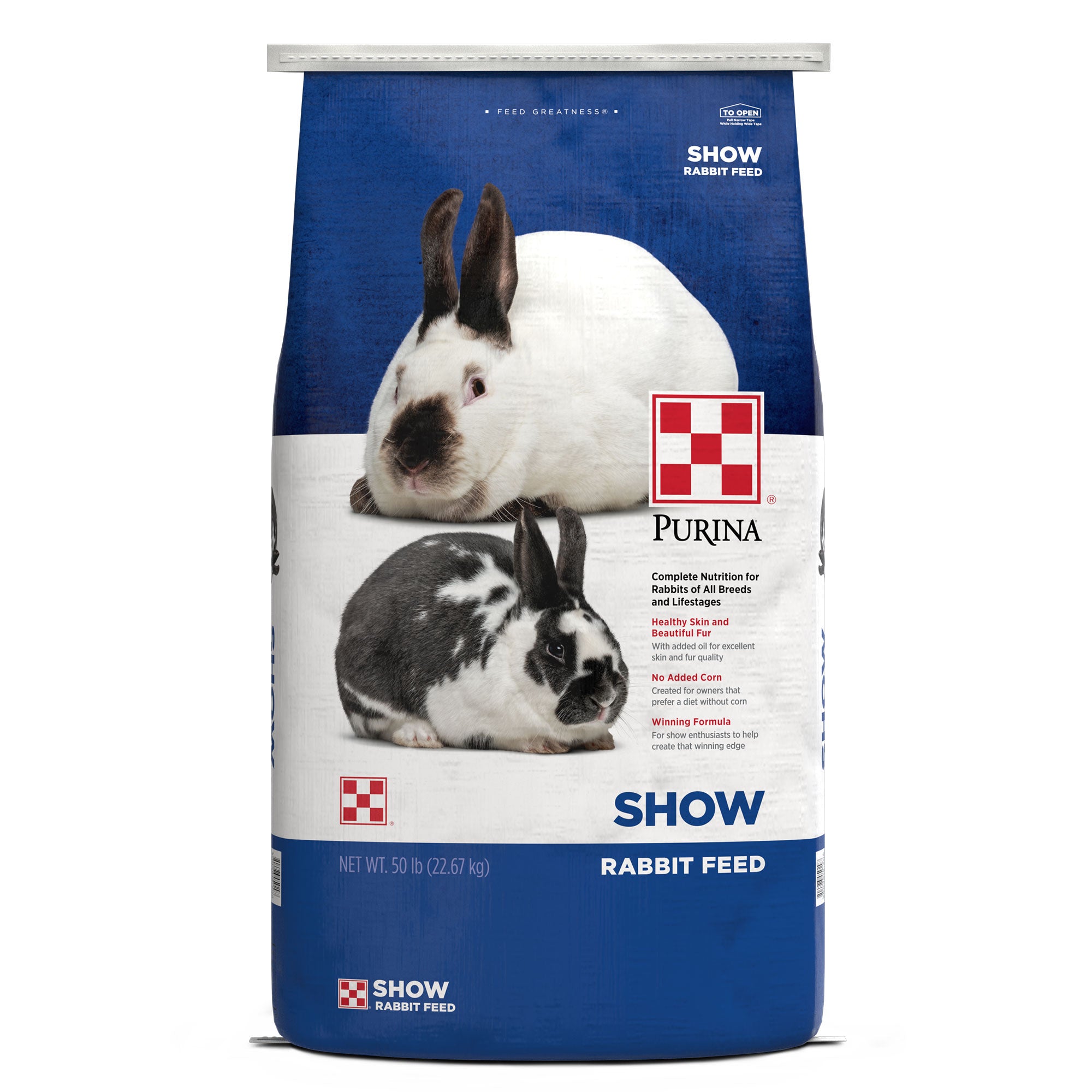
Purina Show Rabbit Feed
Corn-free formula
Dehydrated Alfalfa Meal, Wheat Middlings, Ground Soybean Hulls, Dehulled Soybean Meal, Wheat Flour
Feeding Rate~0.5 oz/lb/day, limit-fed for show. Nursing does: free-choice, 1–3 oz/lb/day.
Find a Dealer →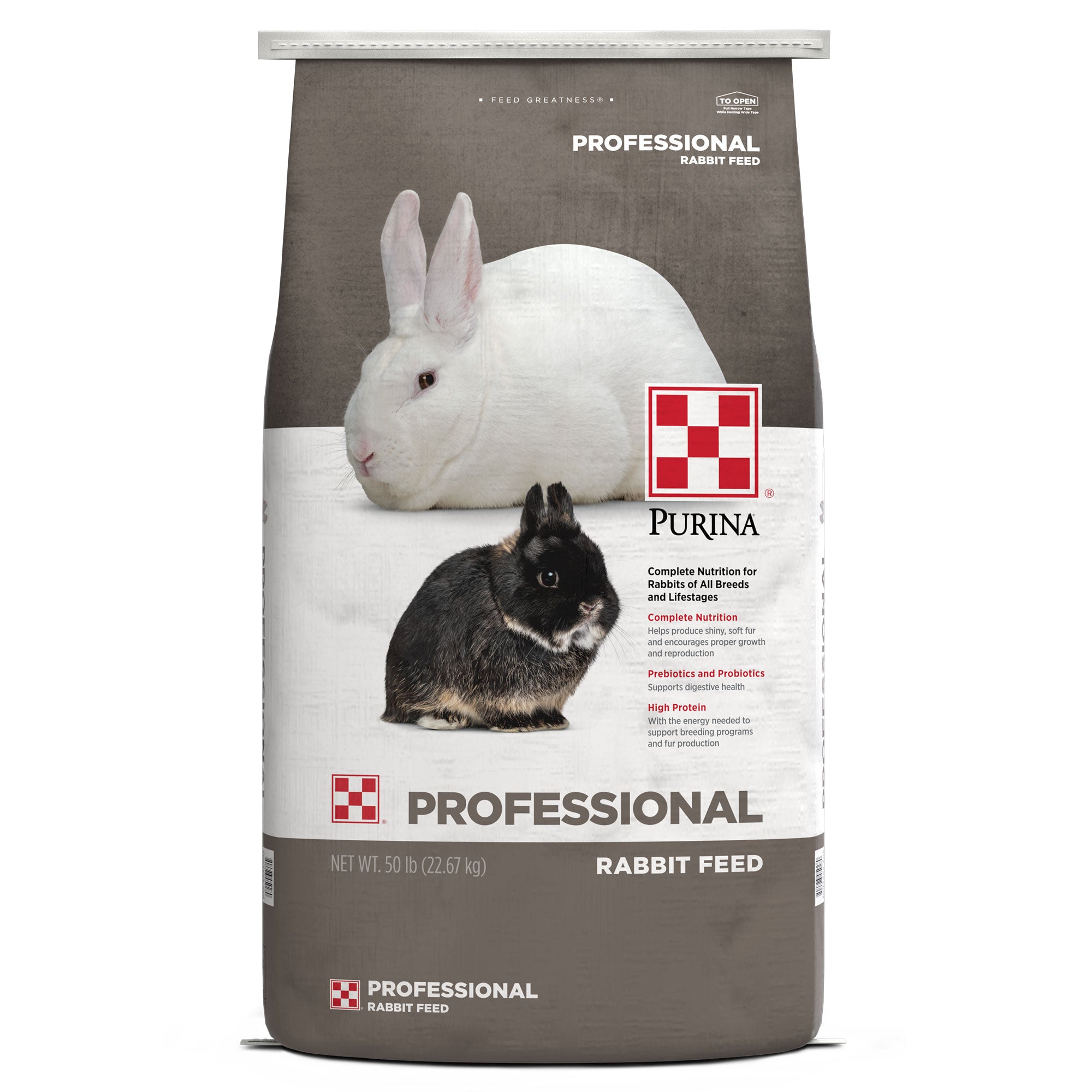
Purina Professional
High-protein, high-energy
Dehydrated Alfalfa Meal, Wheat Middlings, Ground Soybean Hulls, Ground Corn, Dehulled Soybean Meal
Feeding Rate~0.5 oz/lb/day, limit-fed for show/dry stock. Gestating does: 3–6 oz/day.
Find a Dealer →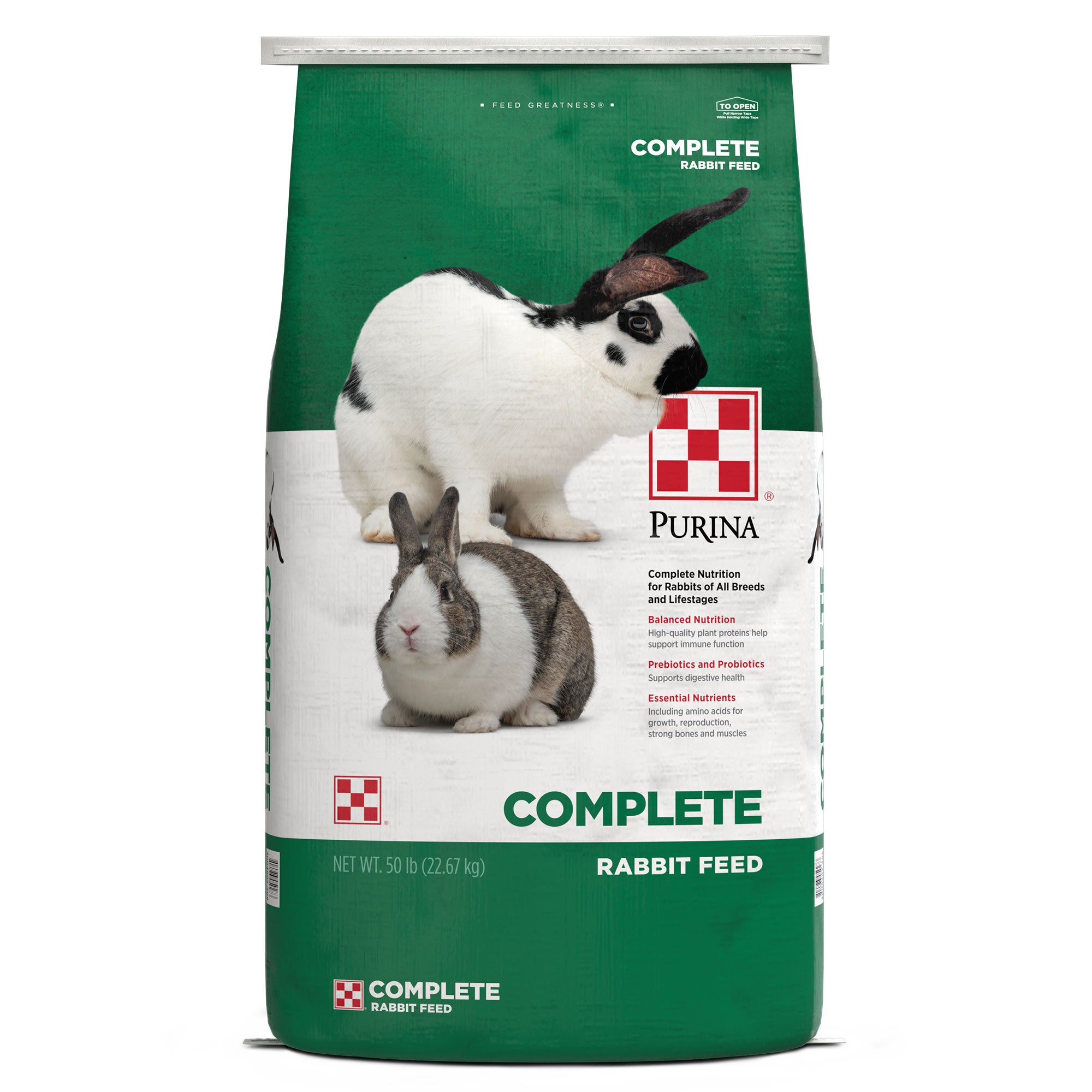
Purina Complete
Everyday, all-ages formula
Dehydrated Alfalfa Meal, Wheat Middlings, Ground Soybean Hulls, Dehulled Soybean Meal, Ground Corn
Feeding Rate~0.5 oz/lb/day for adult, non-lactating rabbits. Lactating does: 1–3 oz/lb/day.
Find a Dealer →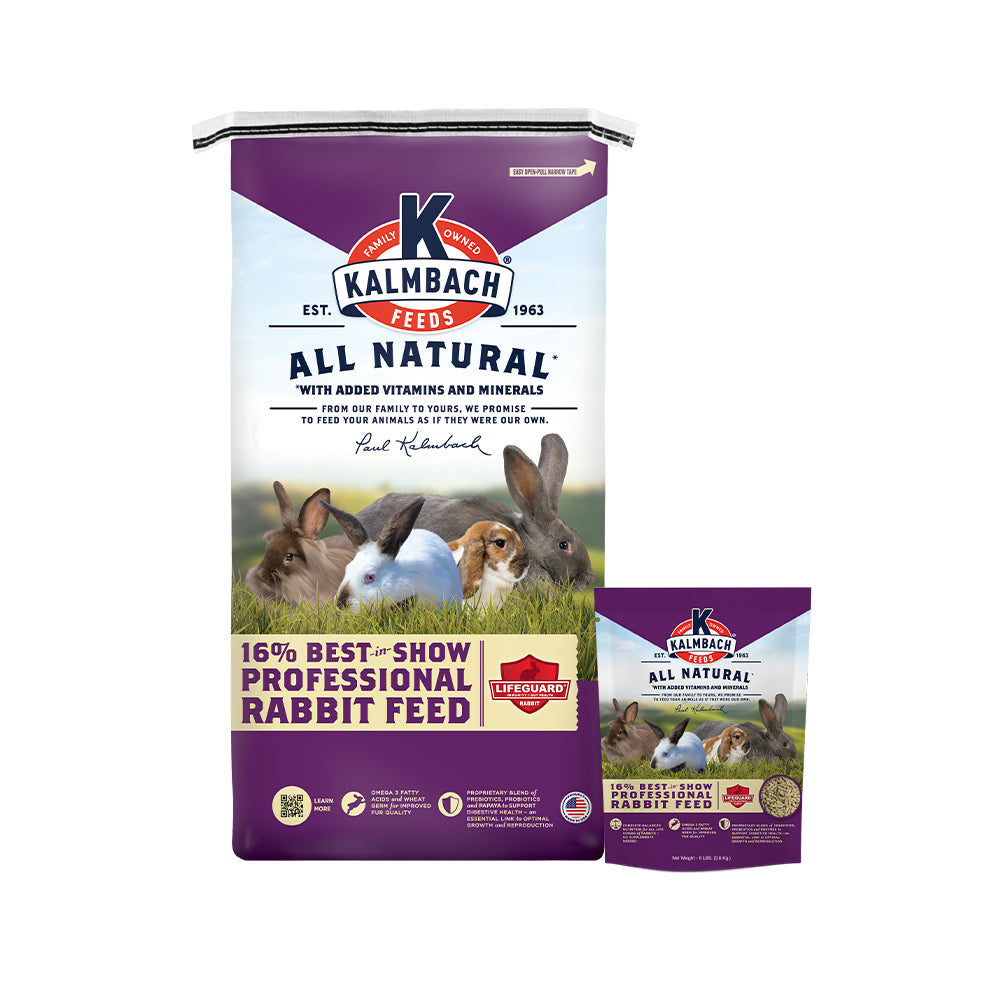
Kalmbach 16% Best-in-Show
Alfalfa & timothy blend
Alfalfa Meal, Timothy Meal, Dehulled Soybean Meal, Processed Grain By-Products, Soybean Hulls
Feeding Rate~0.5 oz/lb/day maintenance/show. Lactating: free-choice, 2–3 oz/lb/day. Growing: 4–6 oz/day.
Find a Dealer →
Kalmbach 18% Best-in-Show
Higher-protein sibling to the 16%
Alfalfa Meal, Timothy Meal, Dehulled Soybean Meal, Processed Grain By-Products, Soybean Hulls
Feeding RateSame schedule as the 16%: ~0.5 oz/lb/day maintenance/show. Growing: 4–6 oz/day.
Find a Dealer →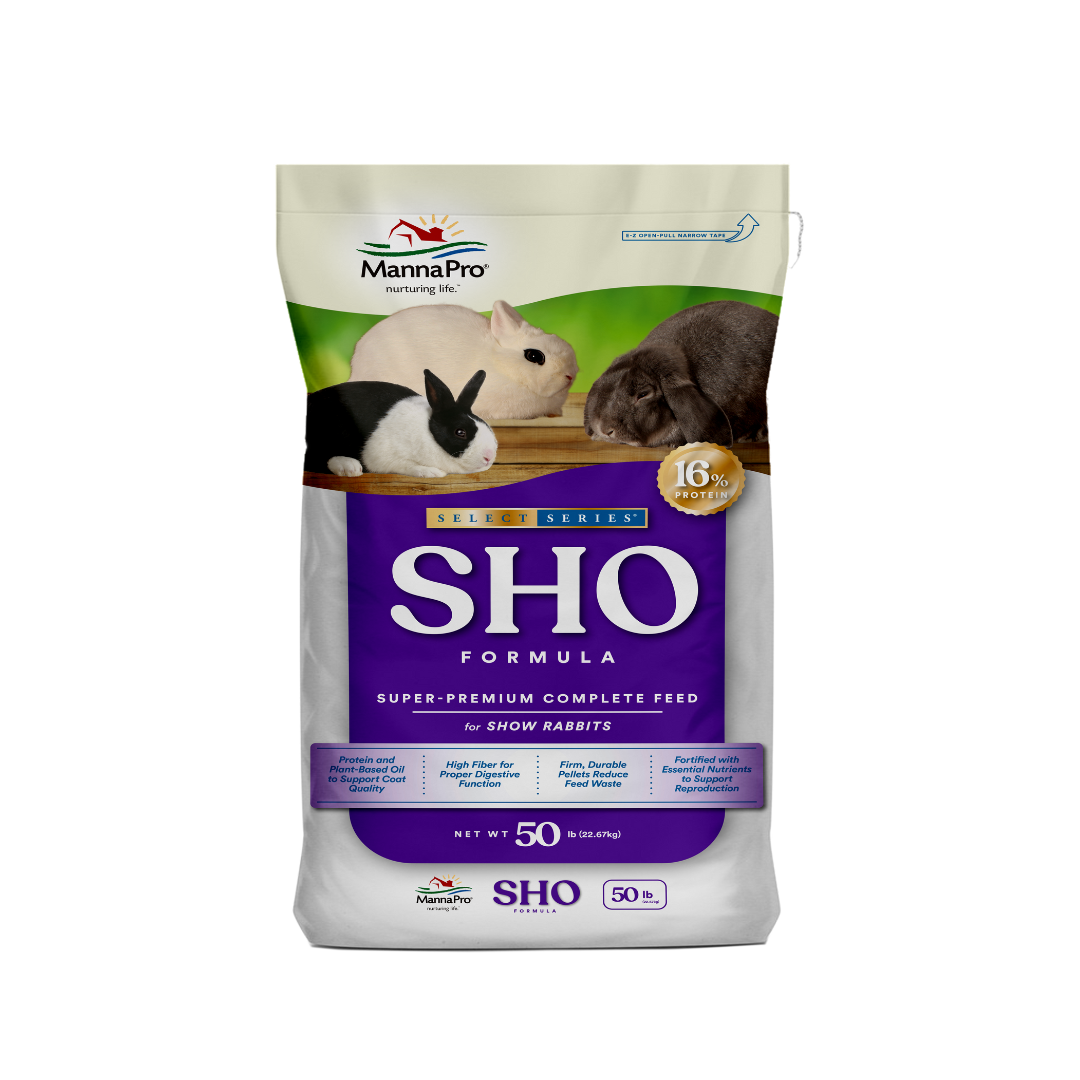
Manna Pro Select Series SHO
Show-specific formula
Dehydrated Alfalfa Meal, Wheat Middlings, Soybean Hulls, Feeding Oatmeal, Soybean Meal
Feeding RateNo specific ounce amount published. Free-choice or limit-fed to desired show condition.
Find a Dealer →
Heinold Commercial Formula
All-around, all life stages
Alfalfa Meal, Soybean Hulls, Wheat Middlings, Soybean Meal, Vegetable Oil
Feeding RateNo specific ounce amount published. Feed as sole ration with fresh water; feed to condition.
Find a Dealer →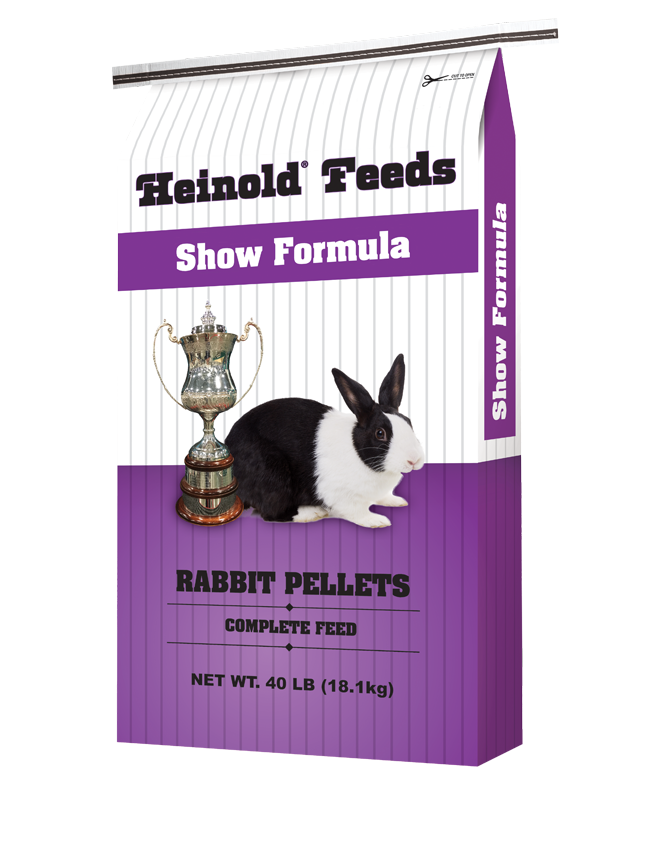
Heinold Show Formula
Heinold's dedicated show ration
Alfalfa Meal (Dehydrated), Soybean Hulls, Wheat Middlings, Soybean Meal, Solvent Extracted Linseed Meal
Feeding RateNo specific ounce amount published. Feed as sole ration with fresh water; feed to condition.
Find a Dealer →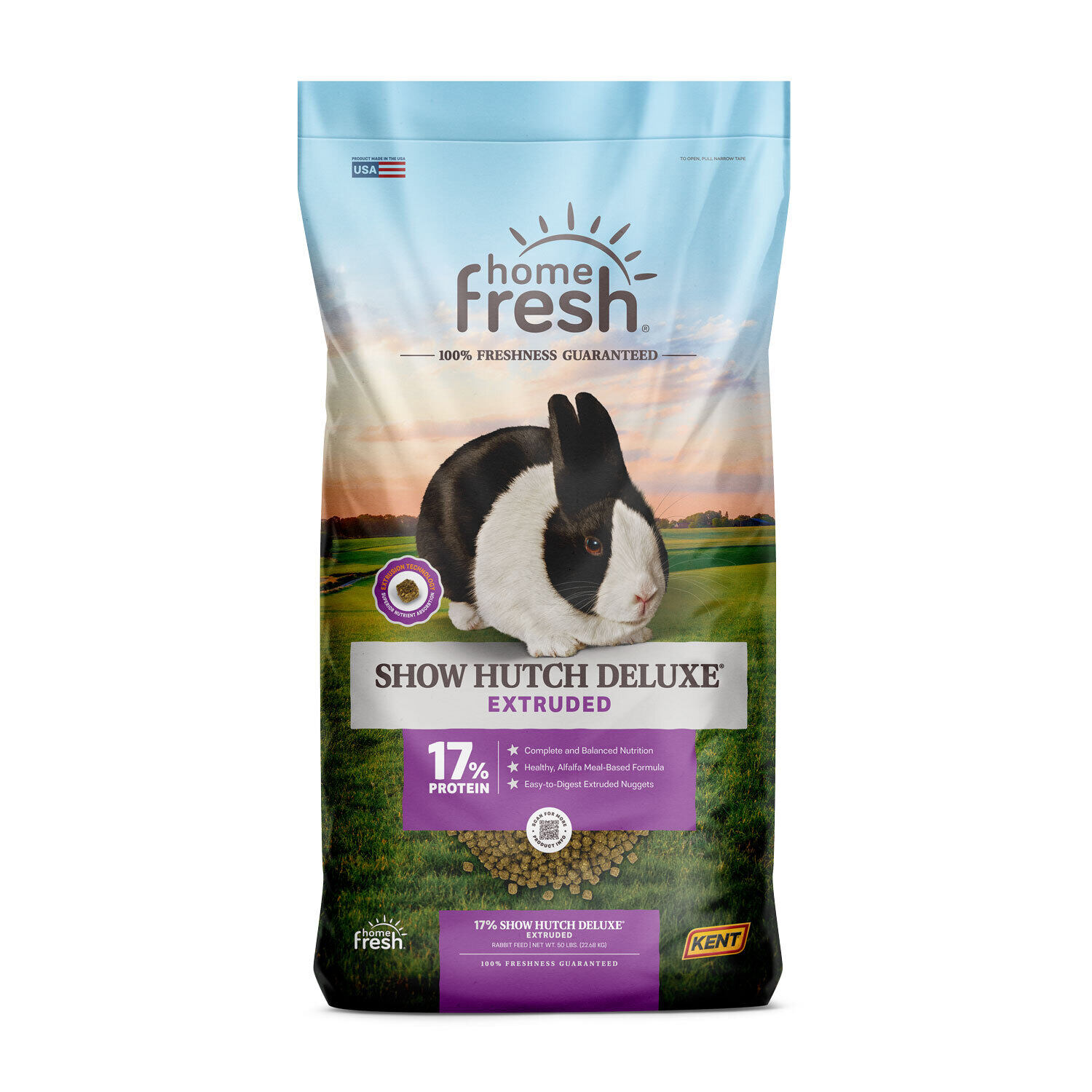
Blue Seal Show Hutch Deluxe 17
Extruded, not pelleted
Dehydrated Alfalfa Meal, Wheat Middlings, Soybean Hulls, Wheat Shorts, Soybean Meal
Feeding RateMedium breed: maintenance/show 3–6 oz/day (limit-fed); growth 4–8 oz/day; lactation 8–16 oz/day.
Find a Dealer →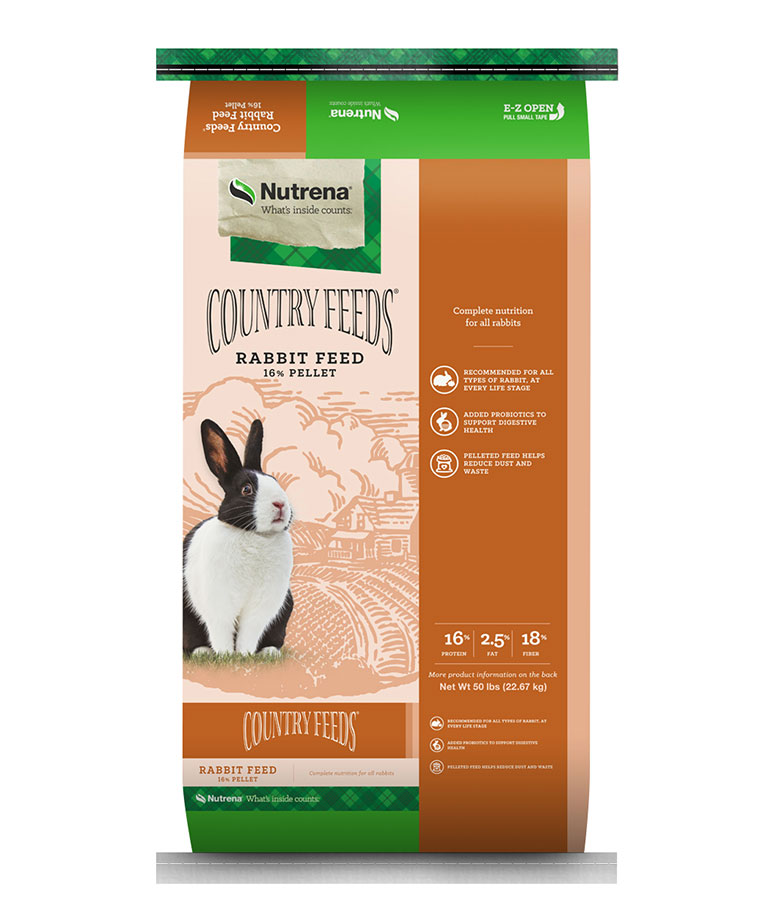
Nutrena Country Feeds 16%
See naming note below**
Wheat Middlings, Dehydrated Alfalfa Meal, Corn Gluten Feed, Rice Hulls, Corn Distillers Dried Grains with Solubles — leads with grain rather than forage (see caution note above)
Feeding RateDry does/bucks: 4–6 oz/day. Does just kindling: 2–3 oz first day to free-choice within 4–5 days.
Find a Dealer →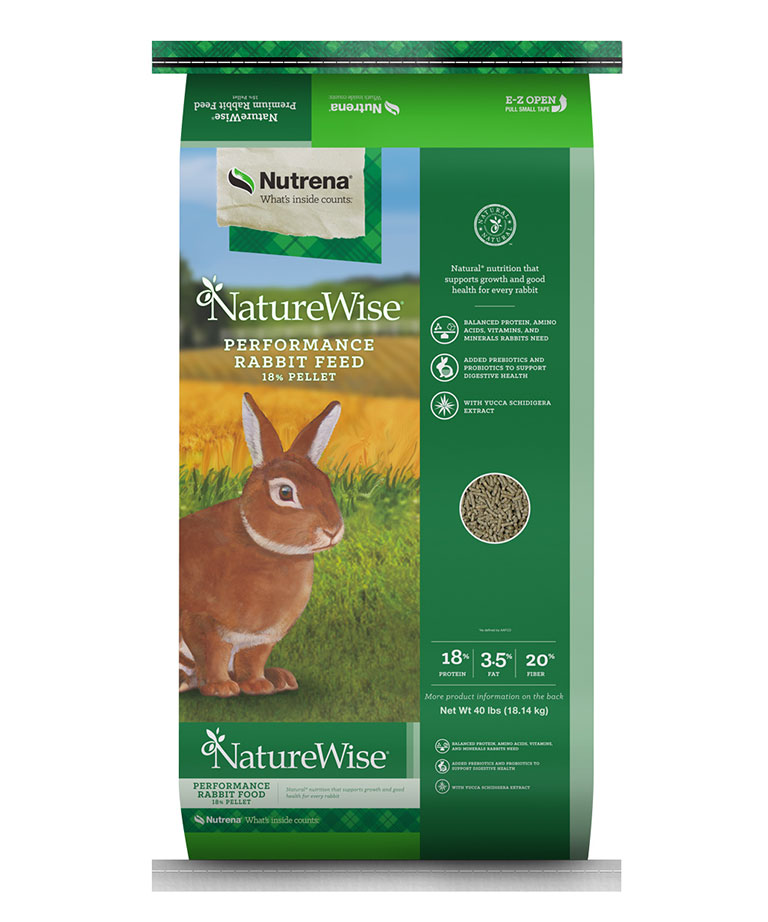
Nutrena NatureWise 18% Performance
Nutrena's actual higher-protein line
Dehydrated Alfalfa Meal, Wheat Middlings, Corn Distillers Dried Grains with Solubles, Rice Bran, Soybean Hulls
Feeding RateDry does/bucks: 4–6 oz/day. Does just kindling: 2–3 oz first day to free-choice within 4–5 days.
Find a Dealer →
Pen Pals Professional Show Rabbit
ADM Animal Nutrition
Dehydrated Alfalfa Meal, Wheat Middlings, Soybean Hulls, Dehulled Soybean Meal, Cane Molasses
Feeding RateBucks: 2–5 oz/day. Resting does: 3–6 oz/day. Gestating does: 4–7 oz/day.
Find a Dealer →*Fiber, fat, and vitamin A figures for the SHO formula reflect Manna Pro's published Select Series range rather than a SHO-specific panel; confirm the exact figures on the bag before purchasing, as formulas are occasionally updated.
**Nutrena's rabbit lineup only sells a 16% protein formula under its "Country Feeds" sub-brand — the "NatureWise" line comes in 15% and 18% versions, not a 16%. Listed here under its correct name, with its official guaranteed analysis and ingredient panel.
Feeding rates above are each manufacturer's own published directions, not our recommendation — some brands publish rates per pound of body weight while others publish flat ounces for a "medium breed," so figures aren't directly apples-to-apples across cards. Always defer to the directions printed on the actual bag. Dealer locators are each manufacturer's own store-finder tool; availability varies by region. Product photos are each manufacturer's own packaging images.
*Fiber, fat, and vitamin A figures for the SHO formula reflect Manna Pro's published Select Series range rather than a SHO-specific panel; confirm the exact figures on the bag before purchasing, as formulas are occasionally updated.
**Nutrena's rabbit lineup only sells a 16% protein formula under its "Country Feeds" sub-brand — the "NatureWise" line comes in 15% and 18% versions, not a 16%. Listed here under its correct name, with its official guaranteed analysis and ingredient panel.
Feeding rates above are each manufacturer's own published directions, not our recommendation — note that some brands publish rates per pound of body weight while others publish flat ounces for a "medium breed," so figures aren't directly apples-to-apples across rows. Always defer to the directions printed on the actual bag, and adjust for your rabbit's condition as described in the FAQ below. Dealer locators are each manufacturer's own store-finder tool; availability varies by region.
A Few Rules of Thumb
Beyond the numbers, a handful of habits do more for a rabbit's condition than any single bag ever will.
- Buy fresh, buy small. Feed is a perishable product. Vitamin content drops the longer a bag sits, so buy only what your herd will finish in two to three months, and store it in a cool, dry place away from light.
- Transition slowly. Switch feeds over seven to ten days, mixing a little more of the new formula in each day. A sudden switch is one of the most common triggers for digestive upset in an otherwise healthy rabbit.
- Pair pellets with hay. Even a well-formulated pellet is meant to complement free-choice grass hay, not replace it. The long-strand fiber in hay does work that a pellet alone can't.
- Judge the whole bag, not one number. The best feed for your rabbitry balances protein, fiber, fat, and ingredient quality together — not whichever bag has the highest protein on the shelf.
FAQ
The questions that come up most once someone actually starts comparing bags.
Do I need to feed hay if my rabbit is already eating one of these pellets?
Most of these are labeled "complete feeds," meaning they're formulated to meet a rabbit's needs without hay. That said, offering free-choice grass hay alongside pellets is still worth doing: the long-strand fiber in hay does mechanical work — wearing teeth evenly and keeping the gut moving — that a compressed pellet can't fully replicate, no matter how high its fiber number is.
Is corn bad for rabbits?
Not inherently — several of the feeds on this list include corn or corn byproducts with no issue, and it's a legitimate energy source. Some breeders prefer corn-free formulas out of concern for starch load or mold and mycotoxin risk in poorly stored grain, which is a reasonable preference rather than a food-safety requirement. If a rabbit is doing well on a corn-inclusive feed, there's no nutritional reason to switch.
How much should I actually feed?
Feeding rates vary by feed and by rabbit, but a common starting point across these brands is about 0.5 ounce of pellets per pound of body weight per day for a rabbit at maintenance — adjusted up for growth, lactation, or a rabbit running lean, and down for one carrying extra weight. Body condition, checked by hand, should drive the final amount more than any printed number.
Can I mix two different feeds together?
It's better to pick one and transition fully rather than mix two feeds long-term. A slow transition over 7–10 days is meant to end with the rabbit fully on the new feed; feeding two formulas side by side indefinitely makes it hard to know which nutrient levels a rabbit is actually getting, and lets a rabbit selectively eat one over the other.
Do show rabbits need a different diet from pet rabbits?
Not fundamentally — a healthy adult pet rabbit and a healthy adult show rabbit have the same underlying nutritional needs. What differs is condition management: show breeders are often fine-tuning fat and protein a little higher in the weeks before a show to influence coat and body condition, which is why several of the feeds above are explicitly meant to be limit-fed rather than left out free-choice.
Why does my rabbit's coat still look dull on a good feed?
A dull coat can come from several places besides the feed itself: a stale bag (vitamin A and fat can degrade before the protein number does), an underlying health issue, or a normal seasonal molt — not a diet failure. Coat changes from a new feed also take several weeks to show up. If a coat stays dull for longer than a full molt cycle on a fresh, well-formulated feed, that's worth a vet visit rather than another feed swap.
Does a higher protein number always mean a better feed?
No. Protein is one of four numbers that matter together, and a feed with a high protein number but a low fiber number is a specialized, limit-fed product — not automatically a "better" one. The right feed is the one whose whole profile, protein, fiber, fat, vitamin A, and ingredient quality together, matches what a specific rabbit needs.
What if none of these twelve feeds are available near me?
These twelve are widely distributed but not universal, and availability depends heavily on region. If none are carried locally, use this guide's guaranteed-analysis and ingredient-list principles to evaluate whatever your local feed store does carry — the physiology behind each number doesn't change from brand to brand.
This page is intended as general education on how to read a feed label, not as veterinary or nutritional advice for an individual rabbit. For a specific health, breeding, or diet concern, consult your veterinarian.
Sources- National Research Council nutrient requirements for rabbits, as summarized in Merck Veterinary Manual, "Nutrition of Rabbits" — merckvetmanual.com
- Michigan State University Extension, "4-H Rabbit Tracks: Feeds and Feeding" — canr.msu.edu
- Texas 4-H and Youth Development, "Rabbit Essentials" feeding guidelines
- Akande, K.E., "The Requirements of Protein and Amino Acids in Rabbit Nutrition and Production" — SSRN
- Manufacturer guaranteed-analysis and ingredient panels: Purina Mills, Kalmbach Feeds, Manna Pro, Belstra Milling / Heinold® Feeds, Kent Nutrition Group / Blue Seal, Cargill / Nutrena, and ADM Animal Nutrition / Pen Pals®
- Breeder-reported feed use, cross-checked against discussion on RabbitTalk.com and the rabbit-keeping forums at BackYardChickens.com
Last verified against current manufacturer guaranteed-analysis panels and breeder discussion: August 2026.
Formulas are updated periodically by manufacturers — always confirm current figures against the tag on your own bag.
For general education only — not veterinary advice. CJM Legacy Rabbitry is not a veterinary practice; nothing here should be used to diagnose, treat, or make medical decisions for a rabbit. Needs vary by animal and formulas change over time, so confirm figures on the bag and consult a rabbit-savvy vet for your rabbit's specific needs.